Poker Cheat Sheet
New to Texas Hold'em? This is the stuff worth keeping in front of you while you learn: what beats what, which hands to play, where to sit, and when the odds are good enough to call. Print it or save it and check it as you go.
Most hands come down to three things: what beats what, whether your hand is worth playing, and whether the odds are good enough to call. This sheet covers all three for Texas Hold'em. Jump to what you need, or read straight through, it takes about five minutes.
Want it on paper? Grab the whole cheat sheet as a clean one-page download.
Download PDF Download imagePoker hand rankings
Best to worst. Ties are broken by the highest cards, then by kickers. Suits never break a tie in Hold'em.
Want the exact odds of each hand and how ties break down to the kicker? See the full poker hand rankings.
Best starting hands
Rough groups for a normal cash game. The top tiers play from any seat. Lower ones want late position or a cheap look at the flop.
Premium
Strong
Playable
Usually fold
s = suited (both cards one suit), o = offsuit. Suited hands are worth more because they can make flushes.
Preflop ranges by position
Roughly how much of all hands to open-raise when you are first into the pot, 9-handed cash. The later you sit, the more you open.
| Position | Open | Opening hands, in short |
|---|---|---|
| UTG (first) | ~10% | Pairs 66+, AJs+, KQs, AQo+ |
| UTG+1 / UTG+2 | ~13% | Pairs 44+, ATs+, KJs+, AQo+ |
| MP | ~16% | Pairs 22+, A9s+, KTs+, QJs, AJo+ |
| Hijack | ~20% | Add suited connectors, KJo, ATo |
| Cutoff | ~27% | Wider suited aces, KTo/QTs, more connectors |
| Button | ~45% | Any pair, most suited hands, most aces, broad offsuit |
| Small blind | ~40% | Wide, but out of position for the rest of the hand |
Want the exact 13×13 grids? Every square, every seat, ready to print.
Printable Preflop Cheat SheetTable positions
Here is where everyone sits at a full 9-handed table. Action moves clockwise, and the numbers show who acts first before the flop. The later you sit, the more you get to see before it is your turn, which is why the button is the best seat in poker.
| Seat | Where | How to play it |
|---|---|---|
| UTG | First to act | Tightest range. The whole table acts behind you. |
| UTG+1 / UTG+2 | Early | Still tight; a lot of players left to act. |
| MP | Middle | Open a little wider; still cautious. |
| Hijack (HJ) | Late-middle | Start opening up and stealing. |
| Cutoff (CO) | Right of button | Open wide, attack the blinds. |
| Button (BTN) | Best seat | Acts last after the flop. Play the most hands here. |
| Small blind (SB) | Forced bet | Posts half a blind, then acts first postflop. Tricky. |
| Big blind (BB) | Forced bet | Posts a full blind. Defend widely, you already have money in. |
More detail on each seat and why it matters: the poker positions guide.
Pot odds & outs
An "out" is a card that makes your hand. Count your outs, then use the rule of 2 and 4 to turn them into a rough win percentage.
| Draw | Outs | Turn + river (×4) | One card (×2) |
|---|---|---|---|
| Flush draw | 9 | ~35% | ~19% |
| Open-ended straight | 8 | ~32% | ~17% |
| Flush + gutshot | 12 | ~45% | ~26% |
| Two overcards | 6 | ~24% | ~13% |
| Gutshot straight | 4 | ~17% | ~9% |
| Pocket pair to a set | 2 | ~8% | ~4% |
Rule of 2 and 4
2 cards to come: outs × 4.
1 card to come: outs × 2. It slightly overstates big draws, but it is close enough at the table.
Pot odds
Call amount ÷ (pot after your call). Call $50 into a $150 pot means you need to win 25% of the time. If your draw beats that, the call profits.
Count outs the fast way with the outs calculator, or get exact equity for any spot with the odds calculator.
The betting rounds
A hand of Hold'em runs through four betting rounds. The blinds seed the pot before any cards are dealt.
New to the game? The full walkthrough is in how to play poker.
Strategy rules of thumb
Nine habits that cover most of winning poker. They are defaults, not laws, but don't break them by accident.
Play tight, then aggressive. Fold most hands, but bet and raise the ones you do play.
Raise or fold, do not limp. Entering for just the big blind gives up the initiative.
Position is power. Play more hands the later you act; fold more from up front.
Continuation bet. If you raised preflop and it checks to you, usually bet the flop.
Let the math decide draws. Call when your pot odds beat your chance of hitting.
Bet your value hands. Do not slowplay a monster on a draw-heavy board.
Standard sizing. Open around 2.5x the blind; three-bet to roughly 3x an opener.
Bluff with backup. The best bluffs are draws that can also win by hitting.
Mind your bankroll. Play stakes you can lose a buy-in at without flinching.
Printable one-page cheat sheet
The same stuff squeezed onto one page you can actually print: rankings, starting hands, the seats, the odds and the key rules. Stick it next to your screen, or save the image to your phone and pull it up when you need it.
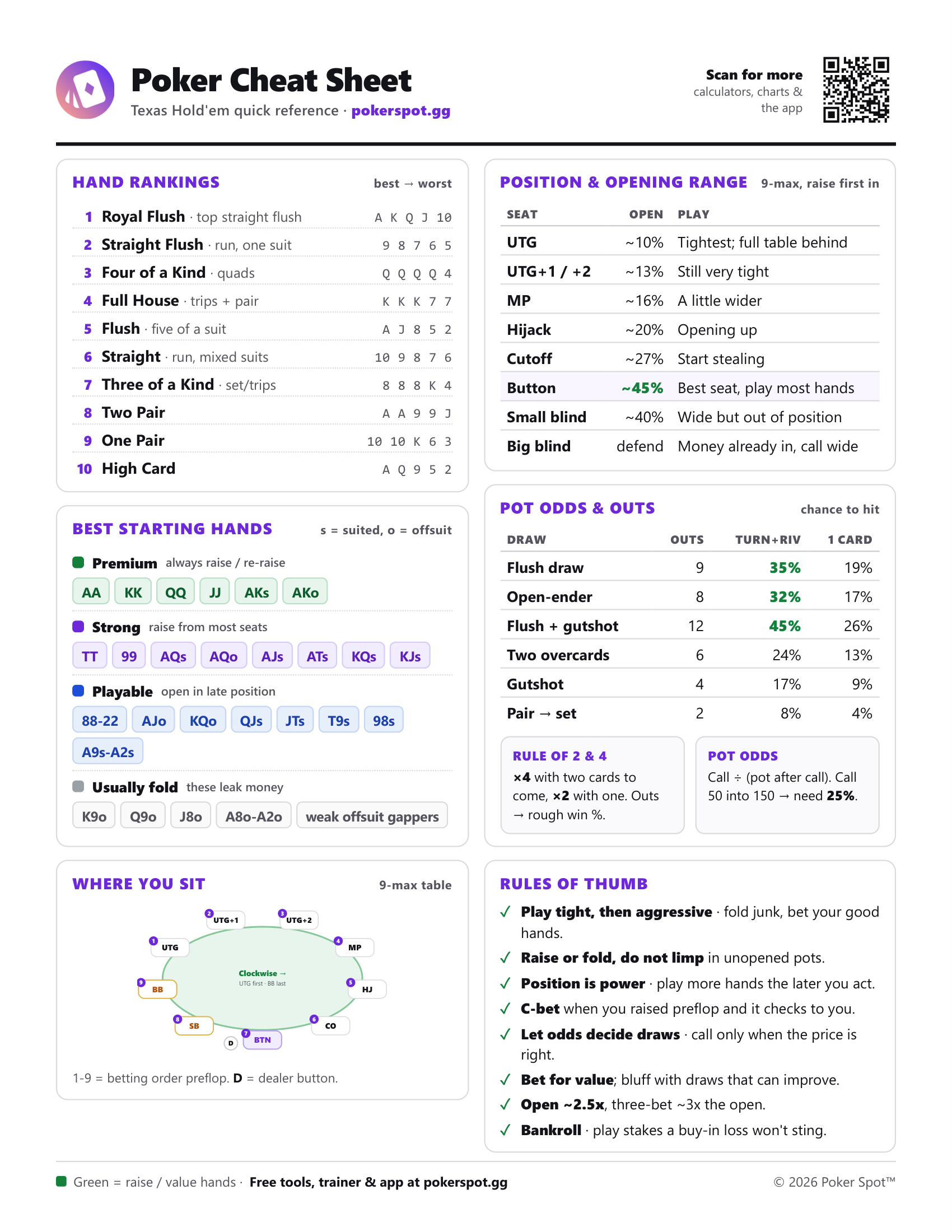
How to use it
Beginners lose money two ways: playing too many hands, and calling when the odds are bad. Fix those two and you are already ahead of most of the table. Before the flop, check the starting-hand tiers and your seat, then ask if the hand is really worth playing from there. Usually it isn't, and folding is the right move. If you are chasing a draw after the flop, count your outs, use the rule of 2 and 4 for a rough chance of hitting, and only call if the pot is paying you enough. That is most of winning poker, right there.
From cheat sheet to second nature
A cheat sheet is fine while you are learning, that is what it is for. One thing to know: most online sites don't allow a chart open during a hand, so use this for studying and home games, not live at the online tables. The point is to stop needing it. After enough hands the rankings, ranges and odds just stick. That is what Poker Spot is for. It drills the same ranges until you know them cold, quizzes you on odds in real spots, and tracks your sessions so you can see where you are leaking chips. The sheet gets you going now; the app makes it automatic.
Frequently asked questions
What is a poker cheat sheet?
A one-page reference for the basics you look up most: what beats what, which starting hands to play, how your seat changes things, and the quick odds for calling a draw. It is a memory aid, not a bot. You still make the decisions.
Is it legal to use a poker cheat sheet?
For studying and home games, yes. Online is different. Almost every site bans having help open during a hand, and a chart counts. So learn from it away from the table and go from memory when you play for real.
What are the best starting hands in poker?
Aces, kings, queens, jacks and ace-king are the premium hands. Play them hard from anywhere. After that come tens, nines and the big suited cards. Everything else depends on your seat and how cheap it is to get in.
How do I calculate pot odds quickly?
Count your outs and multiply by four with two cards to come, or by two with one card to come, for a rough win percentage. Then work out the price: what you have to call divided by the pot after you call. If your win chance beats the price, calling makes money.
What beats what in poker?
Strongest to weakest: royal flush, straight flush, four of a kind, full house, flush, straight, three of a kind, two pair, one pair, high card. Same category? The higher cards win, and the kicker settles it if you are still tied.