Poker Hand Rankings
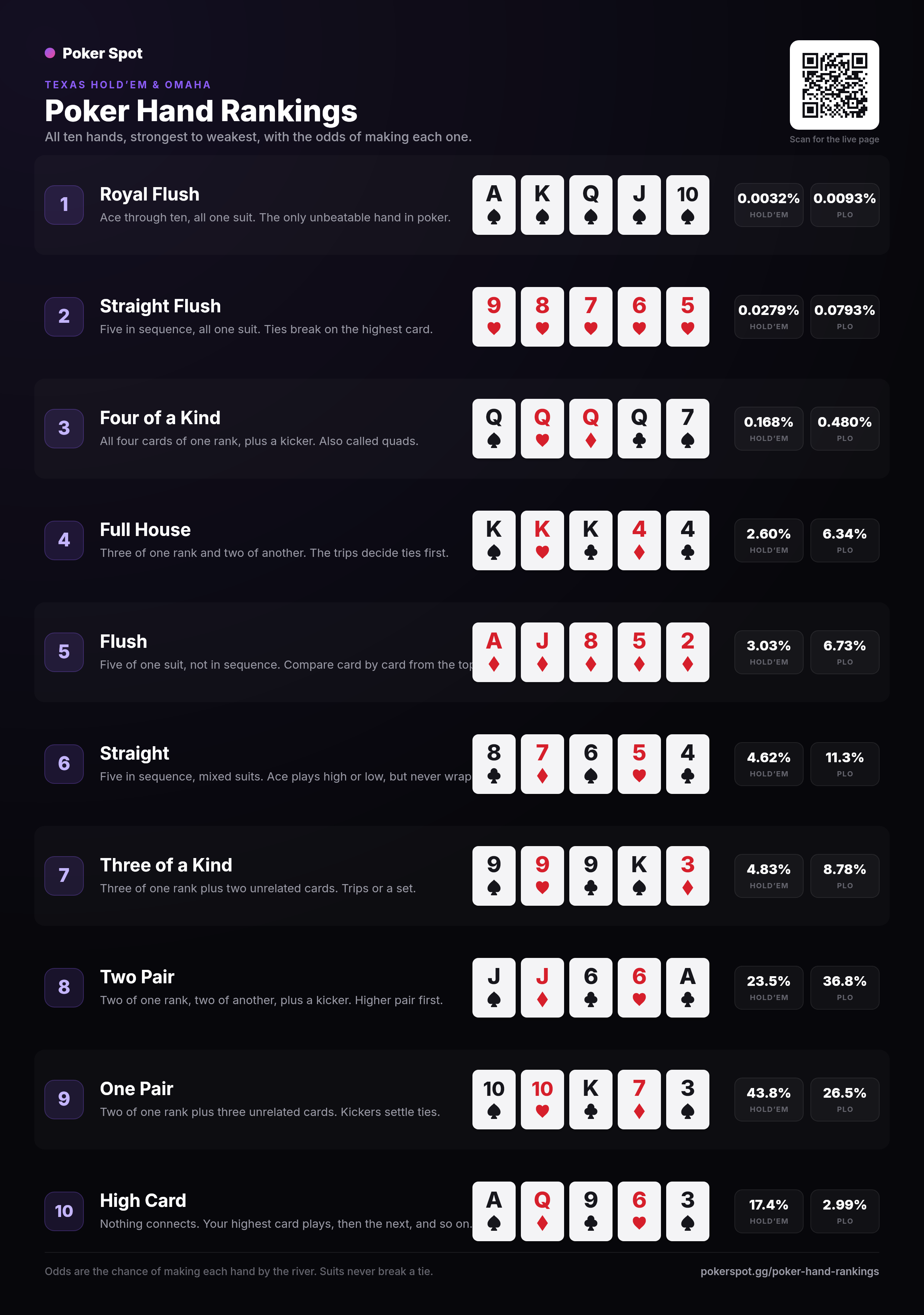
All ten hands, strongest to weakest, with the real odds of making each one.
Every form of poker that uses the standard hand ranks, Texas Hold'em, Omaha, seven-card stud, five-card draw, settles showdowns with the same ten-rung ladder. The best five-card hand wins. Suits never break a tie. If you are brand new to the game, start with how to play poker and come back for the details here.
The Hold'em column is the chance your best five out of seven cards ends up as that hand, out of 133,784,560 combinations. The PLO column is the same figure for pot-limit Omaha, where you are dealt four cards and must use exactly two of them with exactly three from the board. Both assume you see all five community cards. Two extra hole cards make almost everything easier to hit, which is why high card all but disappears in Omaha: you finish with a pair or better 97% of the time.
Why the order is what it is
The ranking is not arbitrary. It comes from five-card draw, where each hand beats the one below it because it is harder to be dealt. In five random cards, half of all hands are high card, 4.75% are two pair, 0.144% are a full house, and four hands in 2.6 million are a royal flush. Rarity is the whole logic, and every other game inherited the same ladder.
Once community cards enter the picture, those frequencies stop lining up so neatly. In Hold'em the order still holds, but the gaps change shape: a straight (4.62%) and three of a kind (4.83%) sit almost on top of each other, and a flush becomes easier to make than a full house, which is why full houses beat flushes even though a flush uses five specific suited cards.
In Omaha the pattern breaks openly. Two pair (36.8%) turns up more often than one pair (26.5%), and a straight (11.3%) more often than three of a kind (8.78%), yet each still beats the hand below it. The ladder is fixed by five-card rarity, not by how often a hand shows up in the game you happen to be playing. The practical lesson is the same one every Omaha player learns fast: two pair is close to worthless there, and the hands that win pots start around the top of the chart.
How ties are broken
When two players make the same category of hand, the tie is settled inside that category, and suits are never used to break it.
- Both have a pair: the higher pair wins. If the pairs match, compare kickers one at a time from highest to lowest.
- Both have two pair: highest pair first, then the second pair, then the single kicker.
- Both have a flush: compare all five cards from the top down. A flush to the ace beats a flush to the king.
- Both have a straight: the higher top card wins. Nothing else matters.
- Both have a full house: the three-of-a-kind decides it. The pair only matters if the trips are identical.
- Everything matches: the pot is split. This is common in Hold'em when the board plays.
Common questions
Does a flush beat a straight?
Yes. A flush is harder to make than a straight, so it ranks higher. This is the single most common mix-up among new players.
Does a full house beat a flush?
Yes. A full house sits one rung above a flush.
Is an ace high or low?
Both, depending on the straight. An ace can be the top of a broadway straight (A-K-Q-J-10) or the bottom of a wheel (5-4-3-2-A). It cannot wrap around, so Q-K-A-2-3 is not a straight, it is just an ace-high hand.
What is a kicker?
A kicker is an unpaired side card used to break a tie. If you hold A-K and your opponent holds A-Q on an ace-high board, you both have a pair of aces, and your king kicker wins the pot.
Do suits rank against each other?
Not in standard poker. Spades do not beat hearts. If two hands are genuinely identical, the pot is split. Some home games and tournament chip-draws use suit order, but that is a procedural rule for dealing, not for showdowns.
What is the best starting hand in Hold'em?
Pocket aces. Against a single random hand it wins about 85% of the time, and it stays the strongest starting hand at every table size, though its edge narrows as more players see the flop.
Practice these until they are automatic
Knowing the ladder is the floor, not the ceiling. What separates winning players is reading a board fast and knowing what your hand is actually worth against the hands that keep betting. Try the odds calculator to see how any two hands run against each other, the outs calculator to learn the odds of completing a draw, and the preflop charts to learn which hands are worth playing in the first place.
Poker Spot turns this into practice: study your own hands, drill preflop and postflop spots, and track every session so you can see which decisions are actually making you money.